

Knowing your rights in the IEP process isn’t just nice to have — it’s what helps you speak up when something doesn’t feel right. And let’s be honest, even in the most positive, team-oriented IEP meetings, there can be moments where something doesn’t quite sit right. And when you’re sitting across from a full team of educators, it can feel intimidating to push back.
This week, we’re breaking down some of the most common things schools say (that aren’t always quite right) and giving you real ways to respond so your child’s IEP actually reflects their needs — not just what’s easiest to provide.

“They say, you say”
We hear it all the time — confusing, misleading, or just plain incorrect statements in IEP meetings, especially when parents ask for supports like OT, speech, a 1:1 aide, stronger goals, or inclusion. Our ongoing “They Say, You Say” series breaks down what you might hear — and how to respond with confidence.
- 11 worst things said in IEP meetings (and how to respond)
- 5 ways to respond in an IEP meeting when denied related services
- 6 ways to respond when discussing goals in an IEP meeting
- 8 ways to respond to IEP disagreements about placement and inclusion
Fight for your right — to disagree!
As a parent, you have rights, more than you might realize. Under IDEA, there are built in procedural safeguards for the rights of children with disabilities and their parents. Many of these are essential advocacy tools that can help ensure a parent’s voice is heard.

- Want a second opinion? You can request an independent educational evaluation (IEE) if you disagree with the school’s assessment or feel it missed key areas.
- Not ready to sign off on everything in the IEP? In California, signing partially allows those parts you agree with (for example, speech services and goals) to move forward while keeping the parts you disagree with on “stay put,” following whatever is in the previously signed IEP.
- School making a change? It should be in writing. Prior written notice (PWN) is a document that the school or district must provide before making or refusing to make a change to a student’s IEP, and when used properly, it can be an empowering tool that creates a paper trail, especially if you need to file for due process.
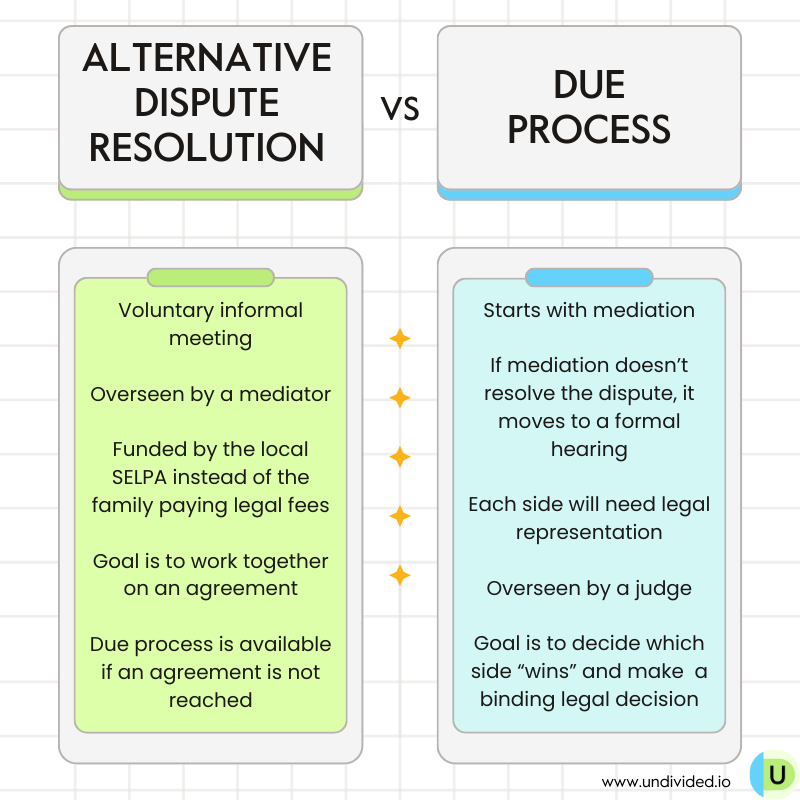
- Want to resolve things without escalating? In California, alternative dispute resolution (ADR) offers a more collaborative way to work through disagreements with the school. ADR is often the first stop before mediation and due process.
- Still at a standstill? Sometimes, disputes can be resolved by talking through disagreements or through alternative dispute resolution. But sometimes, that may not be enough. Due process is a formal option when other attempts to resolve the issue haven’t worked.
Undivided Updates → California legislation: spring 2026
Nearly 1,800 new bills have been introduced to the California legislature for the 2026 session. We sifted through them to find those relevant to Undivided families —such as special education services, mental health access, IHSS, Regional Center, and Medi-Cal accessibility — so you don’t have to! Plus, what to do if you want to help get them passed. Read our spring 2026 California legislation update→

FREE live Q&A: Standards-Based IEPs Done Right
Join us on Thursday, April 9, 12:00 p.m. PT for a FREE live Q&A with Education Advocate and Former Education Director Dr. Diana Fannon as we discuss how to improve access to standards-based curriculum, how to use Core Content Connectors, what kids miss out on with alternate curriculum, how to ask for more inclusion with peers, and ways to push back against schools that want to lower the bar for kids with IEPs. Register for free here→
FREE live Q&A: Getting Ready for Summer with Regional Center and the Self-Determination Program
If your child is a Regional Center client in California, summer may open the door to services like additional respite hours, social-recreation programs, camps, and individualized supports. Join us on Thursday, April 30, 12:00 p.m. PT for a FREE live conversation and Q&A with Undivided’s Public Benefits Specialist and Self-Determination Program Consultant as we talk about how families can prepare for summer now. Register for free here→
Office hours: Special education and IEPs
If you have questions about your child’s accommodations, services, goals, or anything else in their IEP, join us for office hours with Non-Attorney Education Advocate and inclusion specialist Karen Ford Cull on Wednesday, April 8, 12:00 p.m. PT. During office hours, you can ask your question in our members-only Zoom session and get answers right away. If you’re not a member, sign up here to participate.
Undivided Conversations: Streaming on Facebook and YouTube
- Saturday, April 4, 10:00 a.m. PT. – Flip the Script on IEPs. Join us this weekend for this re-streamed conversation with Undivided’s Non-Attorney Education Advocate, Lisa Carey, as she breaks down how to respond to some of the most common things said in IEP meetings — so you can head into your IEP prepared, confident in your rights, and with a clear plan.

 What should you do if the school sends you a PWN? Hear from education advocate Dr. Sarah Pelangka on YouTube→
 Team Undivided represented at last week’s Abilities Expo in Long Beach! Thank you to everyone who stopped by to say hi! See the highlights on our Instagram→
 This week in our private Facebook group for caregivers: disability representation in the movie “GOAT,” funding equipment with SDP, upcoming free webinars, and more. Introduce yourself and join the discussion→
 Help us share IEP tips with families and providers! Share Undivided resources on LinkedIn→
Undivided Voices Podcast → S2E11: Supporting Mental Health in Children with Disabilities: A Guide for Parents
Mental health is a critical part of every child’s well-being — but for children with disabilities, it’s often overlooked or misunderstood. This episode unpacks the unique mental health challenges faced by children with disabilities, why these needs are so often missed, how behaviors can be misinterpreted, and what families should be looking for when it comes to emotional and psychological support. Now streaming on Spotify, Apple Podcasts, Amazon Music, and anywhere you get your podcasts.